
If you’re leading a startup or medium sized organisation right now, it can feel like you’re behind.
Someone on LinkedIn just vibe-coded a full outbound engine in a weekend.
Another founder built a lead scoring model with three prompts and a Zapier flow.
Someone else claims their AI SDR is booking 40% more meetings than their human team.
And you’re sitting there thinking: “Wait… are we supposed to have vibe-coded our entire GTM stack already?”
Let’s take a beat.
Vibe coding tools are incredible. They’re real, they’re transformative, and yes, they’re reshaping how marketing and revenue teams operate.
But for early-stage and small teams, they can also become a very expensive distraction.
(Not to mention how they’re also rapidly contributing to serious burnout according to the Harvard Business Review in their latest study)
The Seduction of Scaling Before You’re Ready
The promise of vibe coding is speed and efficiency…
Spin up landing pages in minutes.
Automate outbound in an afternoon.
Generate content at scale.
Deploy chatbots, SDR agents, enrichment flows, scoring logic – all without writing traditional code.
It feels like leverage. And in many cases, it is. But here’s the truth: A faster drummer doesn’t fix a bad song… ie: automation only scales what already exists.
- If your positioning is fuzzy, automation scales confusion.
- If your ICP is unclear, automation scales wasted outreach.
- If your messaging doesn’t resonate, automation scales indifference.
Small teams are often tempted to use vibe coding tools to create momentum when what they really need is clarity.

The Hardest Work Isn’t Technical, It’s Foundational
Startups without massive datasets don’t have the luxury of pattern recognition at scale.
You can’t “optimize the funnel” if you don’t yet know:
- Who your best-fit customer truly is
- What urgent problem they’re trying to solve
- Why they should choose you instead of the next alternative
- What buying triggers actually move them
When you don’t have deep data, you need discipline in:
- Customer interviews
- Message testing
- Clear differentiation
- Value articulation
- Thoughtful positioning
These aren’t flashy. They’re not likely to trend on LinkedIn. But they are the difference between a scalable engine and a very sophisticated noise machine.
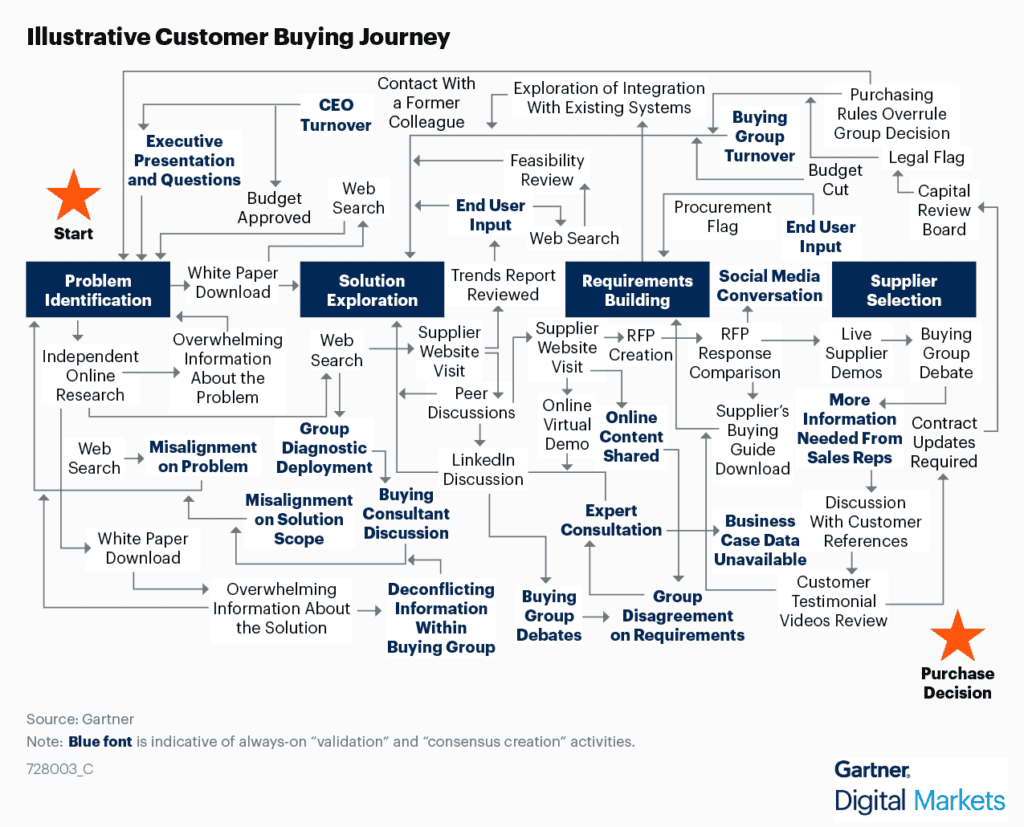
Yes, Technology Is Changing the Buying Journey. Dramatically.
We should absolutely be paying attention to structural shifts happening right now:
- Buyers are researching differently and AI is shaping discovery and evaluation.
- Response time expectations are collapsing and personalization is becoming table stakes.
Ignoring these changes would be naïve. But here’s the nuance:
The more automated the world becomes, the more clarity becomes a competitive advantage.
When AI floods the market with content, the companies that win are the ones that can articulate a sharp point of view, clearly define the problem they solve, demonstrate meaningful differentiation and build trust through consistency.
Technology amplifies. It does not invent positioning for you.
Why Small Teams Feel the Pressure
For early-stage companies, there’s an additional psychological layer. When you don’t yet have a predictable pipeline, a validated ICP or clear win-loss insights, it’s deeply tempting to believe the answer is tooling.
“If we just build the right stack…”
“If we automate more…”
“If we deploy AI agents…”
It’s accessible. Affordable. Exciting. But again, tools don’t replace fundamentals. And scaling something unproven is often more expensive than moving slowly and getting it right.
Build The Backbone Before The Backbeat
At KickDrum, we love what’s happening in AI and GTM tooling. We use it. We experiment with it. We build with it. But we’re also relentlessly focused on fundamentals.
Because before you scale, you need:
- Clear Positioning
- What category are you actually in?
- What do you want to be known for?
- Defined ICP & Buying Triggers
- Not just firmographics, but situational context.
- Articulated Value Proposition
- What changes for your customer if they work with you?
- Message-Market Resonance
- Language that reflects how your customers actually think and speak.
- Disciplined Testing Loops
- Hypothesis > test > learn > refine.
This is unglamorous, “roadie” work. It requires conversations, iteration, and sometimes uncomfortable insights.
But it’s what makes scaling effective instead of chaotic.
Fractional Marketing For Building Foundations
Many early-stage companies don’t need a 10-person marketing team.
They need experienced, strategic thinking with clear direction, execution discipline and structured approach to experimentation
That’s where fractional marketing becomes powerful. At KickDrum, we help companies:
- Clarify and sharpen positioning
- Define and validate ICPs
- Build messaging frameworks
- Design practical, right-sized GTM strategies
- Introduce automation and AI thoughtfully, after the core is solid
We don’t just “turn on more channels.” We help ensure you’re scaling something worth scaling.
So… Should You Vibe Code Your GTM Stack?
Maybe. If:
- You know exactly who you’re targeting
- Your message consistently resonates
- You’ve validated what drives pipeline
- You understand your unit economics
- You’re ready to amplify what’s working
Then vibe coding tools can be a force multiplier.
But if you’re still figuring out who cares, why they care and most importantly: why you?
Then your highest leverage move isn’t more automation. It’s clarity.
From Garage Band To Main Stage
The teams that win over the next few years won’t be the ones with the most AI workflows.
They’ll be the ones who:
- Understand their customers deeply
- Communicate with precision
- Differentiate clearly
- And use technology to amplify proven signal
Innovation is exciting. Discipline is powerful. Together, they’re unstoppable.
If you’re building and feel the pressure to automate everything before you’ve nailed the basics, you’re not behind. You’re at the stage where fundamentals matter most.
And that’s exactly where we do our best work.
Learn more about our team, or get in touch to see how we can help.