
Getting this wrong can compound the challenges you’re trying to overcome.
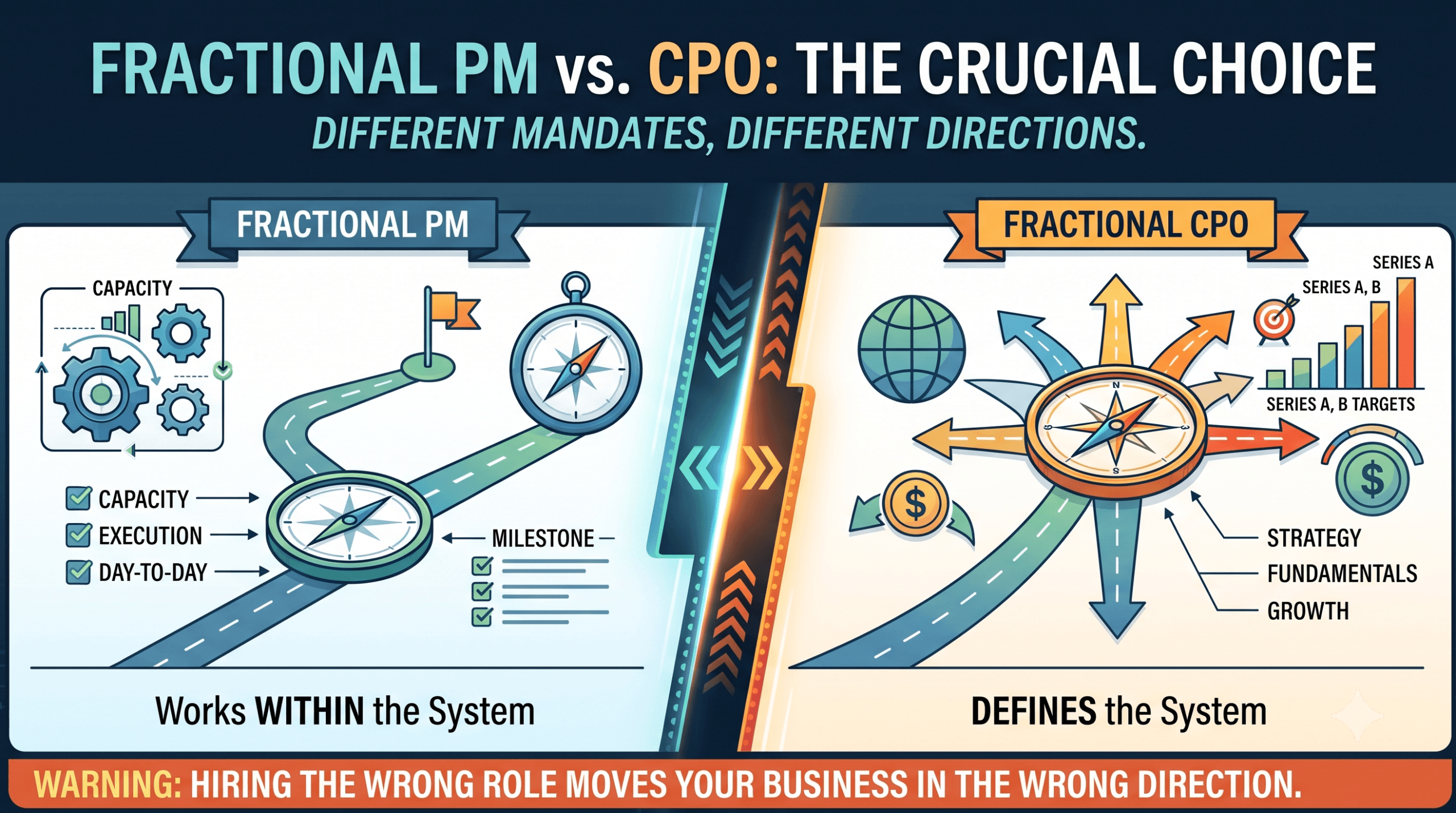
“We need product help” is a diagnosis that stops one level too soon. A fractional product manager and a fractional CPO are not the same job at different seniority levels. They are different jobs with different mandates, and hiring one when you need the other can break a company.
What a Fractional Product Manager Does
Freeing up the C Suite from day-to-day product activities
A fractional PM does the job within the context they are given. They manage to maintain the roadmap, keep cross-functional teams coordinated, run sprint planning, and make sure the backlog reflects priorities set by whoever they’re told gets to set them. When this work is important, it should get done correctly. But not necessarily by people with Chief in the title.
The key word is within. A PM operates inside the system. They need someone above them to set direction and protect the roadmap from the deal that just came in. Without that structure, you’ve only added a more credentialed person to juggle organizational chaos.
When a fractional PM is the right answer: your product strategy has been battle-tested, you have high confidence that your roadmap makes sense, and your team lacks the bandwidth or seniority to execute it consistently. You need more capacity in the core activities of product management.
What a Fractional CPO Does
Overhauling the fundamentals of the Product to move the business forward
A fractional CPO is not a senior PM. They do fundamentally different work. Where a PM solves what to build next and how, a CPO solves business-wide commercialization issues.
Solving fundamental business challenges requires looking across product, sales, operations, and go-to-market simultaneously, because the answer is almost never located cleanly inside one of them. A roadmap that keeps shipping without moving revenue is your clearest sign that something upstream is wrong. Figuring out where that bottleneck resides lies outside of day-to-day operations, and so it has to be pursued by someone who is not also managing the day-to-day.
When a fractional CPO is the right answer: deals aren’t closing the way they should and you’re not sure why, you have no roadmap which leads engineers to go on wild goose chases, or you need to re-evaluate your place in the market from a product, price, and positioning perspective. These are CPO problems.
How to Tell Which One You Need
It starts with intellectual honesty
Ask everyone in the room – your head of sales, your CEO, your lead engineer, whoever runs customer success – why your last three deals closed and why the three before those didn’t. If everyone agrees, you probably have an execution problem. No CPO required. But if you get four different answers, that’s a big sign. If you don’t have six deals as a reference point, that’s a more fundamental problem. In both cases a fractional CPO can help. But unless the CEO digs into the latter problem, the business is likely doomed.
The failure modes are worth naming because they’re easy to miss while they’re happening.
In an engineering-led organization, it doesn’t matter how much good practice and product execution discipline they bring. The engineering team will nod politely and keep working on the problem they find interesting rather than the one customers have actually asked to have solved. A CPO can move from engineering-led to product-led or sales-led, which are requirements for becoming a successful business. A PM can’t.
When the loudest voice rules the roadmap, the PM gives the illusion of productivity. The CEO’s pet feature ships. Or the big customer gets their niche feature request. New products can ship, but they don’t. At least not in a repeatable way. Maybe that’s OK for a company looking to close its first 20 deals. But getting to Series A and B requires increasing levels of repeatability that can’t work when you’ve got dozens or hundreds of loudest voices. It takes bringing in a CPO to say no. A PM doesn’t have the right scope.
In each case, these are competent people acting in good faith but not moving the needle for the business. Moving the business is the CPO’s job. That scope doesn’t come with the PM title no matter how good the person holding it is.
Bottom Line
Hire for scope, not seniority
The distinction between a fractional PM and a fractional CPO is more about the scope of the problem you’re trying to solve than their title. If the problem is capacity and execution, bring in a PM. If the problem is commercial performance and you’re not entirely sure what’s driving it, bring in a CPO.
A capable PM hired into a CPO problem will make things move. They’ll organize the backlog, run the sprints, ship the features, and narrow the aperture of the product around whatever signal is loudest in their environment. Six months later the machine will be running better and pointed more confidently in the wrong direction.
Conversely, a CPO hired into a PM problem is a waste of resources. CPOs come at a premium. They have the scars, and they have the acumen to move a business in a way that improves its chances of success.
But for an early stage company, there may not be enough work to satisfy a full work week for either role. And this is where KickDrum Partners becomes a difference maker. Instead of hiring a fractional CPO or PM, you can hire a cohesive fractional go-to-market (GTM) team at a fraction of the cost to the business.
The KickDrum team have the benefit of being industry veterans who have already proven they work well together. And with KickDrum Partners, you can choose to scale up and down the effort of the specialists over time to match business needs.